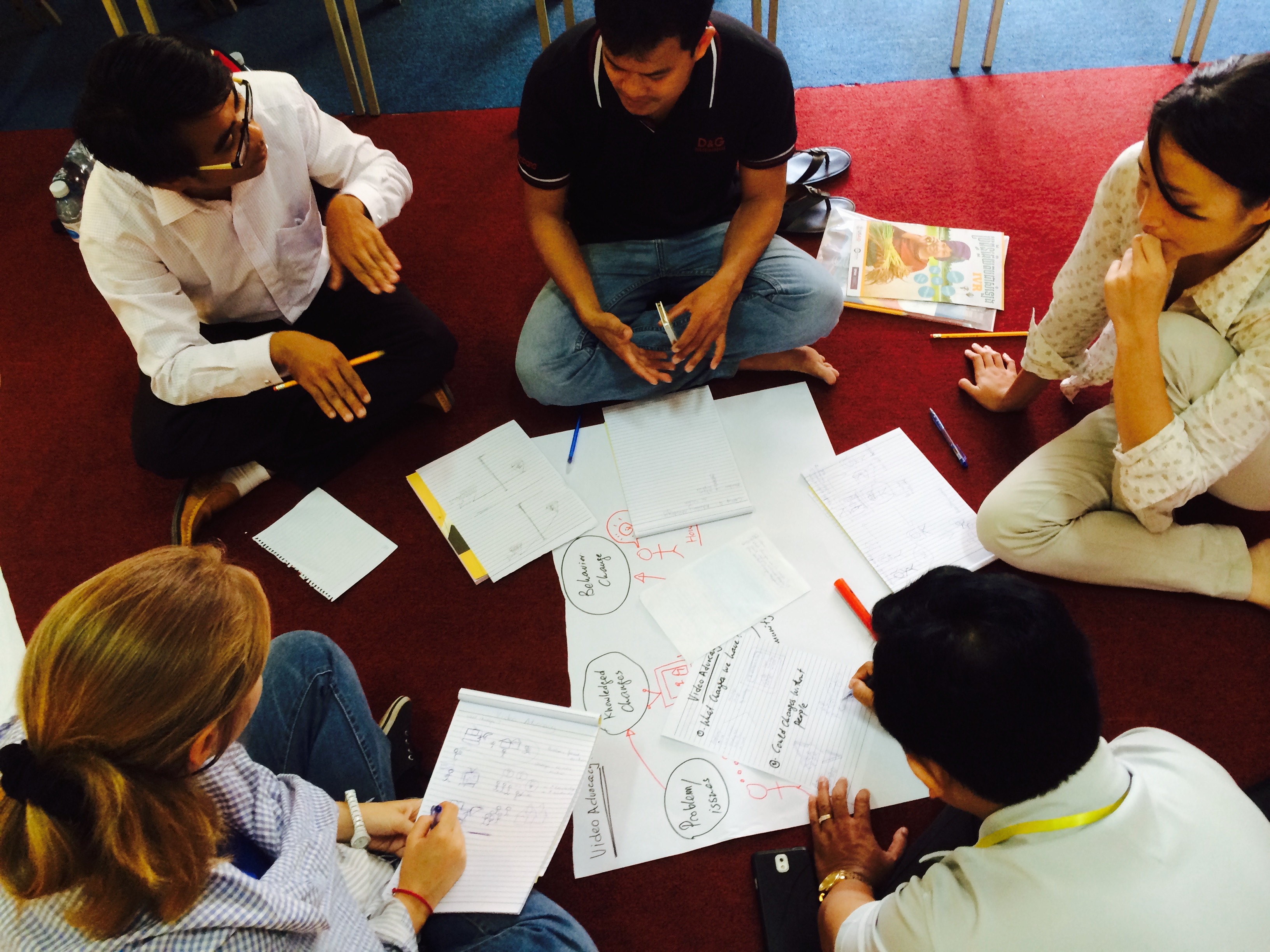
Co-develop dynamic, responsive strategic plans alongside civil society peers.
FabRiders’ Strategy Design cohorts are designed for civil society leaders and practitioners who need to develop or update their organisational or program strategies. Each cohort is envisioned and designed to provide a process framework and practical tools that lead to rich, vibrant strategies. At the foundation of the model are collaborative, participatory, and transparent processes that maximise the quality of input and stakeholder buy-in to produce goals and plans that enjoy broad support and collective ownership.
If you aspire to make your strategy a living practice rather than a static document, this cohort offers a space to develop strategies that are grounded in clear values and purpose, co‑created with the people who will carry them forward, and resilient enough to adapt in uncertain times. This 6-session online cohort is for people holding strategy in civil society organisations who want structured, supported time to rethink how strategy is done in their organisation.
All sessions are online, with two weekly time slots to choose from: Thursdays at 10 am or 4pm UK (London) time.
Our first cohort is now underway, having kicked off on March 19. Applications are open for the next cohort, which is expected to start early-June 2026 — apply below to secure your place.
“Who knew strategy could be so fun and powerful! It completely changed how I think about planning” – Strategy Design Participant
Is this cohort for you?
Join this cohort if you work in a civil society organisation (NGO, charity, network, grassroots group) and you:
- Are you an executive leader, programme lead, organiser, board member or “strategic thinker by default”?
- Have responsibility or influence over strategy, programmes, advocacy, or participation.
You might recognise yourself if:
- You have a strategy remit, but are not sure how to start or what makes for a meaningful and successful planning process
- You’re sitting with a plan that feels outdated.
- You have a theory of change that looks great on paper but doesn’t guide real decisions.
- Your current processes don’t align with your values around participation, power, and lived experience.
This cohort is primarily aimed at civil society organisations, with 9 places available.
“A really valuable space to step back, reflect and plan.” – Strategy Design Participant
What you’ll walk away with
By the end of the cohort, you will:
- Design or refine your strategic planning process (or a strategic initiative) for your organisation, grounded in values, context and uncertainty.
- Learn and apply facilitative leadership to make strategy processes more participatory, transparent and collectively owned.
- Develop practical ways to engage a broad range of stakeholders so you can cultivate shared ownership of your organisation’s direction.
- Understand and apply power analysis tools to see how power shows up and identify specific ways to shift power through strategic planning.
- Stress‑test your strategy against real‑world constraints and changing conditions, and define how you will keep it “living” over time.
- Build a small, trusted peer network of practitioners facing similar challenges in civil society.
What you’ll take back to your organisation:
- A strategic planning roadmap: a concise plan you can take back to your organisation, ready to share, test and iterate with colleagues.
- A Power & Strategy action plan: 2–3 specific, power‑shifting moves to embed in your next strategy cycle (who is involved, who decides, where resources go).
- A living strategy toolkit: a straightforward stress‑testing checklist, reflection questions, and facilitation moves you can reuse as you implement your strategy to keep it alive amid change.
How the cohort works
- Duration: 6 sessions
- Format: Weekly 90‑minute online sessions, plus periodic one-on-one sessions (as needed)
- Cohort size: Up to nine participants to enable depth and interaction.
- Approach: Short inputs and lots of practice – small‑group breakouts, live work on your own strategies, and structured peer feedback.
Dates and times
This cohort runs as online sessions once a week on Thursdays. There will be two parallel online cohorts each week:
- Thursdays at 10 am UK time. (Check your time zone)
- Thursdays at 4 pm UK time. (Check your time zone)
All sessions are scheduled in UK (London) time; you can check what this looks like in your time zonef
“This challenged my thinking about strategic planning in all the right ways.” – Strategy Design Participant
Arc
Each cohort will be tailored to participants’ needs but will follow an arc similar to the following. Across all sessions, participants will give and receive peer feedback and continuously revise their strategic planning process, building towards a near‑final version shared in the final session.
Session 1 – Orientation & Facilitative Leadership for Strategy
- Get to know the cohort and clarify each participant’s real strategic challenge.
- Explore how facilitative leadership can drive a participatory strategy process as an alternative to executive‑driven strategy.
- Practice simple facilitation moves that change who speaks, who decides and how collective intelligence is used, with peer reflections on each person’s initial approach.
Session 2 – Strategy Design Foundations in Uncertain Times
- Revisit strategy building blocks: vision, theory of change, goals, strategies, tactics, assumptions and learning questions.
- Draft an initial “strategy sketch” for each participant’s challenge: clear enough to act on, light enough to adapt.
- Share early sketches in small groups and capture feedback to refine each person’s emerging strategic planning process.
Session 3 – Power, Privilege and Strategy Design
- Surface participants’ own definitions and experiences of power.
- Introduce and work with the four power domains – structural, disciplinary, hegemonic and interpersonal – to inform strategic pathways.
- Identify where power and privilege show up in current strategy practices (who sets the agenda, who decides, who gets what, whose knowledge is used), then adjust individual strategy processes with peer input.
Session 4 – Participatory and Inclusive Strategy Processes
- Turn power insights into concrete process design: who to involve, when and how, so strategy work redistributes voice and influence.
- Explore practices for involving staff, volunteers, communities and partners in ways that are meaningful rather than tokenistic.
- Participants refine their engagement and planning processes, testing them in small groups and iterating based on peer feedback.
Session 5 – Stress Testing & Living Strategies
- Introduce stress testing: subject strategies and processes to plausible future scenarios, constraints and shocks (e.g. funding cuts, political shifts, governance changes, community pushback).
- In structured small groups, participants stress test each other’s strategies and planning processes, challenging assumptions and surfacing risks and unintended consequences.
- Translate insights into adjustments that keep strategies alive: clearer learning questions, decision triggers, feedback loops and “if/then” moves, updating each participant’s near‑final process.
Session 6 – Commitments, Peer Feedback and Next Steps
- Participants share a near‑final version of their strategic planning process and power‑shifting plans and receive focused peer feedback.
- Identify 30–90 day implementation steps, internal conversations and enabling conditions they need to secure.
- Explore best practices and peer ideas for keeping momentum and evolving their “living strategy” beyond the cohort.
“Encouraged open thinking, honest reflection and genuine collaboration. Very valuable and well-designed.” – Strategy Design Participant
Pricing and support options
We aim to balance financial sustainability with accessibility for a range of civil society organisations:
- Small/grassroots organisation rate: £240 per person (organisations with annual income under £500k).
- Standard NGO/charity rate: £360 per person (organisations with annual income between £500k and £5m).
- Solidarity/funder rate: £480 per person (organisations with income over £5m, funders, or those with strong professional development budgets).
- Independent Freelancer/Consultant rate: £120
We are seeking:
- Participants interested in joining the next cohort (starting mid-May 2026).
- Partner organisations and networks to help identify participants and share learning.
- Funders and allies willing to support subsidised places, cover facilitation and coordination costs, and explore future multi‑cohort, regional or issue based version
Want to partner or support subsidised places? Get in touch.
Want to go deeper before you apply?
This cohort grows out of a series of recent blog posts from the Strategy Design Festival:
- Strategy is a verb, not a document – why strategy needs to be a living practice, not a PDF.
- Your theory of change isn’t a theory – how to turn tidy diagrams into living hypotheses that guide decisions.
- Strategy is ALWAYS about power (whether you name it or not) – making internal power visible in your strategy work.
- Keeping Strategy Alive and Real – how to keep strategy alive in the organisational day-to-day
- Strategy is hard, and even harder in isolation – on how capitalism keeps us from building solidarity when we do strategic planning.
You don’t need to read these to join the cohort, but they’ll give you a feel for the questions and practices we’ll be working with.
Origins of the cohort
The design of this cohort is informed by The Strategy Design Festival, held in London in January 2026, where UK‑based civil society leaders called for more structured support to apply ideas on testing theories of change, stakeholder and power mapping, and keeping strategy “alive” within their own organisations. It also draws on FabRiders’ nearly thirty years of experience helping movements, NGOs, and networks develop participatory strategies grounded in real‑world practice, showing how visions of success, theories of change and strategic plans are strengthened when they incorporate diverse perspectives and collective power.